


Blog Post
Posted: 18th August 2026
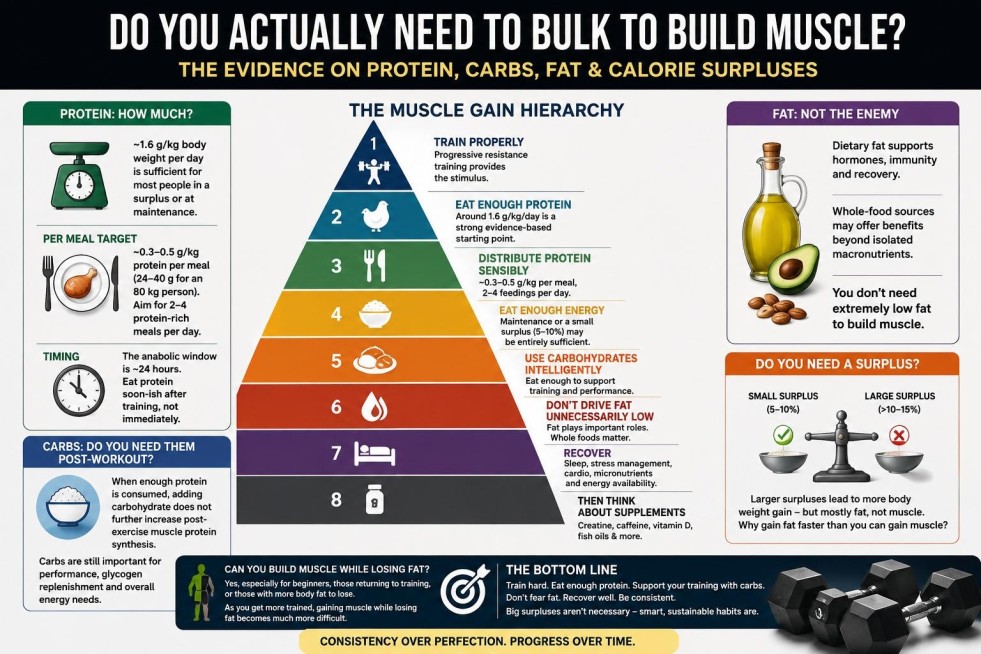
If your goal is to build muscle, you’ve probably heard the same advice repeatedly:
Eat more.
Get your post-workout carbs in.
Never miss the anabolic window.
Bulk first, cut later.
But when we look at the research, muscle gain is considerably more nuanced than simply eating as many calories as possible.
Yes, building muscle requires resistance training, adequate nutrition and recovery. But a bigger calorie surplus does not necessarily mean more muscle, carbohydrates do not need to be consumed immediately after training to create an insulin spike, and protein requirements are probably lower than many people have been led to believe.
So, what actually matters?
Muscle tissue is constantly being broken down and rebuilt.
Muscle hypertrophy occurs over time when muscle protein synthesis (MPS) exceeds muscle protein breakdown (MPB) sufficiently for new muscle tissue to accumulate.
Resistance training provides an important stimulus for MPS, while dietary protein supplies the amino acids needed to support that process.
This makes two things particularly important:
Resistance training + adequate protein intake.
Everything else needs to be considered around those foundations.
More protein isn’t automatically better.
Research suggests it is difficult to demonstrate additional muscle-building benefits once protein intake reaches approximately 1.6 g/kg of body weight per day in people eating around maintenance or in an energy surplus.
For an 80 kg person, that would be around:
80 × 1.6 = 128 g protein per day.
There may be circumstances where higher intakes are useful, particularly during an energy deficit or in populations such as older adults or people consuming predominantly plant-based diets.
But consuming 3–4 g/kg because more protein must equal more muscle isn't supported by the evidence presented here.
It isn't only your total daily protein intake that matters.
Individual meals should contain a meaningful amount of protein capable of stimulating MPS.
A useful practical range is approximately:
0.3–0.5 g/kg protein per meal.
For an 80 kg person, that's roughly 24–40 g protein per meal.
This also helps provide sufficient leucine, an essential amino acid involved in triggering MPS.
Rather than obsessively calculating leucine content, aiming towards approximately 0.4–0.5 g/kg protein in a mixed meal can help account for differences in protein quality.
For most people, around 2–4 adequately sized protein-containing meals per day is a sensible approach.
And importantly, your body doesn't suddenly stop using protein once you've eaten 25 or 30 grams.
Emerging research using larger doses of slower-digesting proteins challenges the idea of a rigid upper limit to how much protein can contribute to anabolism after a single meal.
The anabolic window exists.
It just isn't the tiny window we've traditionally been sold.
Resistance exercise increases the muscle's sensitivity to amino acids, and this increased sensitivity can remain elevated for at least 24 hours.
So yes, consuming protein after training is sensible.
But you don't need to finish your last rep and sprint towards your protein shaker before your gains disappear.
A high-quality protein source after training can be a useful habit, particularly because it makes it easier to meet your total protein requirements.
Think soon-ish, rather than immediately.
This is where an old bodybuilding belief starts to fall apart.
Traditionally, athletes were encouraged to consume large quantities of fast-digesting carbohydrate immediately after resistance training to spike insulin, increase MPS and suppress MPB.
However, research has shown that when sufficient protein is consumed, adding carbohydrate does not appear to further increase post-exercise MPS or meaningfully suppress MPB.
Protein itself generates enough of an insulin response to support these processes.
That doesn't mean carbohydrates are useless after training.
Far from it.
Carbohydrates are valuable for:
But there's an important distinction between:
Carbohydrates being useful for performance and recovery
and
Carbohydrates being required to make your protein more anabolic.
They aren't the same thing.
For someone simply resistance training for muscle gain, carbohydrate intake can therefore be much more flexible than previously assumed, provided it isn't so low that training quality suffers.
Fat often gets pushed aside during muscle-building phases because protein and carbohydrates receive most of the attention.
But chronically driving dietary fat extremely low probably isn't a particularly clever strategy either.
Dietary fat contributes to numerous physiological processes, including sex steroid hormone production, immunity and recovery.
There is also interesting research suggesting that the whole-food matrix may influence the anabolic response to food.
For example, whole eggs have produced a greater post-exercise MPS response than protein-matched egg whites.
Research comparing different types of milk has also raised interesting questions about whether whole milk may improve the utilisation of amino acids for protein synthesis compared with lower-fat alternatives.
That doesn't mean:
More dietary fat = more muscle.
We don't have evidence to make that conclusion.
Instead, it reminds us that foods aren't simply packages of isolated macronutrients. Vitamins, minerals, lipids, choline and other components of whole foods may interact in ways we don't completely understand yet.
The practical takeaway is much simpler:
You don't need an extremely low-fat diet to gain muscle, and there may be good reasons not to use one long term.
Yes!!
But there's a massive it depends attached to that answer.
Muscle gain has been demonstrated during an energy deficit when resistance training and sufficient protein are provided.
One study placed participants in a substantial energy deficit while undertaking intensive exercise. Those consuming 2.4 g/kg protein per day gained approximately 1.2 kg of lean body mass over four weeks, while also losing fat.
So body recomposition is absolutely possible.
However, that doesn't mean everyone can continuously lose significant amounts of fat while simultaneously maximising muscle gain.
It is particularly achievable in people who are:
As someone becomes increasingly trained, the rate at which they can gain muscle slows considerably.
At that point, trying to aggressively lose fat while simultaneously maximising hypertrophy becomes much more difficult.
This is probably one of the most important questions.
Muscle gain and bulking have become almost synonymous.
Want more muscle?
Eat 500 calories above maintenance.
But research doesn't clearly support the idea that aggressively increasing calories produces proportionally greater muscle growth.
In athletes undergoing resistance training, deliberately increasing energy intake produced considerably more body-weight gain than eating more freely, but didn't produce significantly greater lean mass or strength gains.
Where did much of the additional weight come from?
Body fat.
More recent research comparing different surplus sizes similarly suggests that faster rates of weight gain and larger energy surpluses primarily increase fat gain, rather than producing proportionally greater increases in muscle thickness or strength.
This creates an important practical question:
If muscle tissue can only accumulate at a limited rate, throwing another 500–1,000 calories at the body doesn't force it to manufacture muscle at the same rate.
Instead, you're likely increasing the amount of body fat you'll subsequently need to lose.
And every month spent unnecessarily dieting that fat back off is a month that could potentially have been spent training productively around maintenance.
For many people, maintenance calories may be perfectly reasonable, particularly if they're relatively new to resistance training.
If maximising muscle gain is the priority and some body-weight gain is acceptable, a small surplus is a much more sensible starting point than a traditional aggressive bulk.
A practical starting range from the lecture is approximately:
Maintenance to a 5–10% calorie surplus.
For someone maintaining their weight on 2,500 kcal, that's approximately:
2,500–2,750 kcal/day.
Even then, the numbers shouldn't be treated as gospel.
Energy expenditure is dynamic.
When calories increase, some people unconsciously move more through changes in NEAT – non-exercise activity thermogenesis. That means the theoretical 200-calorie surplus you calculated on paper may not actually produce a 200-calorie surplus in the real world.
Monitor body weight, training performance, body composition and the individual's experience, then adjust.
One of the biggest mistakes coaches can make is overpromising how quickly someone can transform their physique.
New lifters can often make impressive progress.
But muscle gain doesn't continue at the same rate indefinitely.
As training experience increases, the potential rate of muscle gain generally declines, while age, genetics, nutrition, recovery and the quality of the training stimulus create enormous individual variation.
This is why generic promises such as gaining a pound of muscle every week make very little physiological sense for a natural, experienced trainee.
Muscle gain is a long game.
Supplements sit towards the top of the hierarchy for a reason.
They aren't going to rescue poor training, inadequate protein, insufficient recovery or inconsistent nutrition.
The lecture highlights several supplements worth considering within the wider context of muscle gain and performance, including:
Creatine, caffeine, vitamin D and fish oils.
L-carnitine is also discussed as an interesting emerging area, particularly because increasing muscle carnitine concentrations appears to require specific conditions involving carbohydrate and insulin.
However, this remains a much more fringe consideration.
It's certainly not where I'd start with the average client.
Get the foundations right first.
If you're trying to build muscle, your priorities should look something like this:
1. Train properly.
Progressive resistance training provides the stimulus.
2. Eat enough protein.
Around 1.6 g/kg/day is a strong evidence-based starting point for many people, with potentially higher requirements during an energy deficit.
3. Distribute protein sensibly.
Approximately 2–4 meaningful protein feedings per day, with around 0.3–0.5 g/kg per meal, is a useful practical framework.
4. Eat enough energy.
You don't necessarily need a traditional bulk. Maintenance or a small surplus may be entirely sufficient depending on your training history and goals.
5. Use carbohydrates intelligently.
Eat enough to support your training demands. You don't need to force huge quantities of sugar post-workout to make your protein work.
6. Don't drive fat unnecessarily low.
Fat plays important physiological roles, and whole-food sources may offer benefits beyond their isolated macronutrient content.
7. Recover.
Sleep, nutrient sufficiency, cardiovascular fitness and overall energy availability still matter.
8. Then think about supplements.
Building muscle isn't about eating as much food and protein as you can tolerate.
And you certainly don't need to spend six months aggressively bulking simply because you want to change your physique.
For most people, the smarter approach is remarkably unexciting:
Train progressively, consume adequate protein, eat enough carbohydrates to support your training, don't unnecessarily restrict dietary fat, recover properly and spend a long time doing those things consistently.
If additional calories are required, introduce them conservatively and monitor what actually happens rather than assuming faster weight gain means faster muscle gain.
Because ultimately, the goal isn't to gain weight as quickly as possible.
It's to gain muscle as effectively as possible while minimising unnecessary fat gain.
Join my 70 day stong challenge here!!

How I can Help you
The 6 month Mindful Gut Healing ACCELERATOR to help you transform your health journey with my 1:1 coaching programme, designed to achieve maximum impact. This tailored approach will help you reach your wellness goals and embrace a life of balance and vitality.
Implement my 3-step process to discover exactly how to cultivate a mindful approach to eating and living. Learn to attract wellness and healing naturally, using proven methods and expert guidance.


