


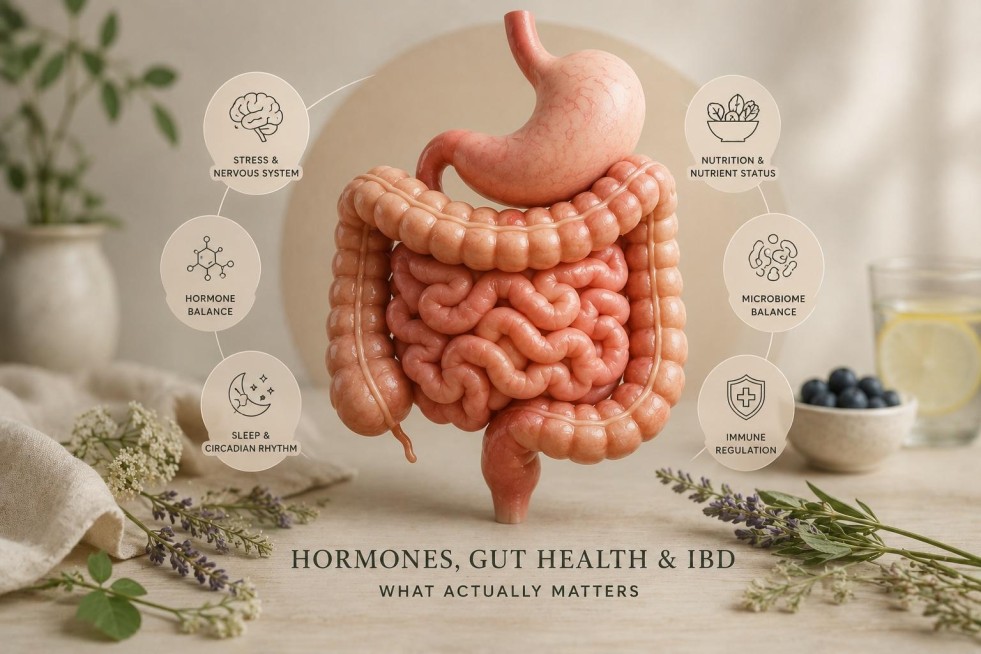
If you live with Crohn’s disease, ulcerative colitis, IBS or ongoing digestive symptoms, it is very easy to end up believing your hormones are either broken, working against you, or sitting behind every frustrating symptom you cannot quite explain. You are tired, your digestion feels unpredictable, your appetite can feel all over the place, your weight may fluctuate, and somewhere along the line someone online tells you it is “just your cortisol”, “an insulin problem”, “adrenal fatigue”, or that you need to “optimise your hormones”.
The problem is that while hormones absolutely matter, the conversation around them is often shallow, exaggerated, and disconnected from the physiology that actually helps people. That is where people get stuck. They end up chasing supplements, avoiding foods unnecessarily, or blaming their body instead of understanding what is really going on.
The more evidence-based and ultimately more empowering truth is that hormones are part of a wider communication system. They influence digestion, appetite, metabolism, sleep, mood, fluid balance and reproductive health, but they do not operate in isolation. They are responding constantly to your nervous system, your gut, your behaviour patterns, your sleep, your stress load, your nutritional status and your overall health. The goal is rarely to “hack” hormones directly. More often, it is to create the conditions that allow the body to regulate itself better. That is where meaningful change usually begins.
The endocrine system is a collection of glands that produce hormones which help regulate metabolism, growth and development, tissue function, sexual function and reproduction, sleep, mood and much more. In plain English, it is one of the body’s main communication systems. It tells tissues what to do, when to do it, and how strongly to respond.
One of the most important concepts here is homeostasis, which is simply the body’s drive to keep things stable. Hormones do not exist to make your body dramatic. They exist to help it stay alive, responsive and balanced. That is why so much hormone regulation works through negative feedback loops, where a stimulus creates an opposite response to bring the body back towards normal. Blood glucose rises, insulin is released, and glucose is brought down. Blood glucose falls, glucagon is released, and glucose is brought back up. The body is always adjusting.
This matters clinically because it reminds us that most of the time we are not trying to force a hormone into doing something superhuman. We are trying to stop the environment around that hormone from pushing the body in the wrong direction.
If you work with the gut every day, or live in a body that constantly gets your attention through bloating, reflux, pain, urgency or fatigue, you already know the gut is not just a food tube. It is a sensory organ, an immune organ, a hormonal organ, and part of a two-way communication system with the brain.
The lecture material makes that link quite clear even when discussing digestion. Appetite hormones such as ghrelin, peptide YY, CCK and GLP-1 influence hunger and fullness. Chewing more has been linked with changes in relevant gut hormones and greater subjective satiety in research by Miquel-Kergoat et al. 2015. Holt et al. 1995 also showed that different foods produce very different satiety responses even when calories are matched, which is one reason why real food structure matters more than a simplistic calories-only conversation often allows.
This is where the gut-brain axis becomes clinically useful rather than just a trendy phrase. Stress, meal timing, food form, symptom expectation, nervous system state and digestive responses are all interacting. A late evening meal can worsen reflux in susceptible people compared with eating earlier, as shown by Piesman et al. 2007. Food combining, despite how often it appears online, did not produce better weight or body fat outcomes when energy and macronutrient composition were similar in Golay et al. 2000. So the practical lesson is not to become more fearful of food. It is to understand what actually changes physiology and what is mostly noise.
Cortisol is commonly called the stress hormone, but that label has done more harm than good. Cortisol follows a normal daily rhythm, peaking in the morning and gradually declining across the day. Acute changes are not a sign your body is failing. They are part of a healthy response to exercise, waking, challenge and energy demand. In fact, resistance training and high-intensity exercise both increase cortisol acutely. That is normal physiology, not a mistake.
Where cortisol becomes relevant is in the context of chronic stress and poor recovery. Schulz et al. 1998 found that highly stressed individuals can show a more prolonged increase in cortisol after waking, and this response may be greater in women. But even here we need nuance. Elevated cortisol does not suddenly stop fat loss. It may increase water retention and therefore mask scale changes, but it does not override energy balance in the simplistic way people are often told.
For people with IBD, IBS or persistent digestive symptoms, this matters because chronic stress can amplify gut sensitivity, influence motility, affect sleep and shape behaviour. The mistake is assuming the answer is a supplement marketed to “lower cortisol”. The better question is what is keeping the nervous system under strain in the first place.
This is worth saying clearly because many people with chronic symptoms have been told they have it. The Endocrine Society states that “adrenal fatigue” is not a real medical condition and that there are no scientific facts supporting the idea that long-term stress drains the adrenal glands and causes the wide range of symptoms often blamed on it.
That does not mean people’s symptoms are not real. They are. It means the label is often unhelpful and can delay proper assessment. Someone may need better sleep, more regular food intake, support for depression or anxiety, medical testing, or simply a more realistic recovery plan. A made-up diagnosis can distract from all of that.
Insulin is produced by the beta cells of the pancreas and helps regulate carbohydrate and protein metabolism, reduce glucose output from the liver, and promote glucose uptake into cells. It also decreases proteolysis, which means it is muscle-sparing, and it reduces renal sodium excretion, which partly explains why rapid changes in carbohydrate intake can shift water balance.
One of the most useful points in the lecture is that insulin also appears to be anorexigenic, meaning appetite-suppressing, rather than appetite-stimulating. Pliquett et al. 2006 is highlighted for this, and it pushes back against the common claim that carbohydrates automatically make you hungrier because they raise insulin. That idea is far more confident than the evidence allows.
For clients with digestive symptoms, this becomes practical very quickly. Some people feel more settled and satisfied with a meal that includes carbohydrate because it supports satiety, energy stability and a sense of being fed rather than merely full. Others need more careful tailoring depending on symptoms, disease activity, tolerances and lifestyle. Again, this is why tailored nutrition beats blanket rules every time.
Thyroid-stimulating hormone, or TSH, stimulates the production of T3 and T4. In the UK, the reference range given in the lecture slides is 0.4 to 4.0 mU/L, with levels above that suggesting hypothyroidism and levels below suggesting hyperthyroidism. The lecture also notes that there is debate around these cut-offs, as discussed by Lewandowski 2015. Symptoms associated with hypothyroidism include weight gain or difficulty losing weight, tiredness, dry skin, constipation, hair loss and feeling too cold.
This is particularly relevant in gut work because constipation, fatigue and weight changes are often automatically blamed on digestion alone. Sometimes that is correct. Sometimes it is not. A nutritionist does not diagnose thyroid disease, but a good practitioner knows when to encourage someone to go back to their GP and ask more questions.
Sleep and exercise stimulate growth hormone release, and fasting can acutely increase growth hormone secretion, including in people with obesity-associated impairment of growth hormone release, as noted in Godfrey et al. 2003, Ho et al. 1988 and Kelijman and Frohman 1991. Low dietary fat intakes have been associated with lower resting testosterone in Broad and Cox 2008. These are interesting physiological observations.
But interesting does not automatically mean clinically game-changing.
That is where the Phillips 2012 paper, Strength and hypertrophy with resistance training Chasing a hormonal ghost, is so useful. The broader point from that debate is that acute spikes in so-called anabolic hormones during training do not seem to explain muscle growth and strength adaptations in the simplistic way the fitness world often suggests.
The same logic applies to gut health. Just because a food, fast, supplement or training style nudges a hormone does not mean it creates a meaningful clinical outcome. Physiology is not a collection of party tricks.
Leptin is produced by adipose tissue and helps regulate energy balance by inhibiting hunger. It is often called the satiety hormone and is opposed by ghrelin, the hunger hormone. In obesity, people may have high leptin levels but become less sensitive to the signal, which is one reason appetite regulation can become more difficult.
That does not mean the answer is a “leptin diet”. It means healthy behaviours improve the environment in which appetite regulation occurs. Sleep, regular meals, adequate protein, reduced chaos, movement and nervous system support all matter here.
The most useful takeaway from this entire lecture series is not that hormones are irrelevant. It is that they are often over-marketed and under-understood. The body is easier to push into dysfunction than into superhuman optimisation. That is a deeply important point for people who are already anxious about symptoms and looking for the missing piece.
In practice, that means your focus should usually stay on the basics that have the biggest downstream effect.
Start eating in a more regular pattern rather than swinging between under-fuelling and overeating, because that gives your gut, your appetite signals and your energy regulation a steadier platform to work from.
Slow meals down where you can. Even something as simple as chewing properly and not inhaling your food can support satiety and reduce the sense that meals are never quite landing.
If reflux is one of your issues, look at timing before obsessing over random food rules. Eating earlier in the evening may help more than endlessly cutting foods.
Do not let social media convince you that food combining is evidence-based. Focus on tolerance, symptom patterns, nutritional adequacy and consistency instead.
If you are exhausted, constipated, cold, losing hair, or struggling with unexplained weight changes, do not assume it is “just your gut”. It may be worth asking your GP to look at thyroid markers properly.
Treat “adrenal fatigue” claims with caution. Real symptoms deserve real assessment, not a made-up diagnosis and an expensive supplement stack.
Use stress management in a practical way. Not as a performative wellness routine, but as a serious physiological intervention for a body that may already be carrying a lot. Better sleep, boundaries, slower mornings, therapy, breathwork, walking and eating in a calmer state all count.
Remember that “hormone balance” is very often the result of repeated behaviours, not a special protocol.
If there is one message I want you to take from this, it is that hormones absolutely matter, but they are rarely the place to start. For most people with gut issues, the real work lies in reducing physiological chaos, supporting the gut-brain axis, eating enough and eating consistently, sleeping better, managing stress realistically, and knowing when something sits outside your scope and needs proper medical input.
That is not a sexy answer, but it is the answer that tends to help.
And honestly, that should bring some relief. Because it means you do not need to become your own endocrinologist. You do not need to “hack” your body. You need to understand it well enough to support it properly.
Book a free consultation call with me here
https://calendly.com/klknutrition

How I can Help you
The 6 month Mindful Gut Healing ACCELERATOR to help you transform your health journey with my 1:1 coaching programme, designed to achieve maximum impact. This tailored approach will help you reach your wellness goals and embrace a life of balance and vitality.
Implement my 3-step process to discover exactly how to cultivate a mindful approach to eating and living. Learn to attract wellness and healing naturally, using proven methods and expert guidance.


